
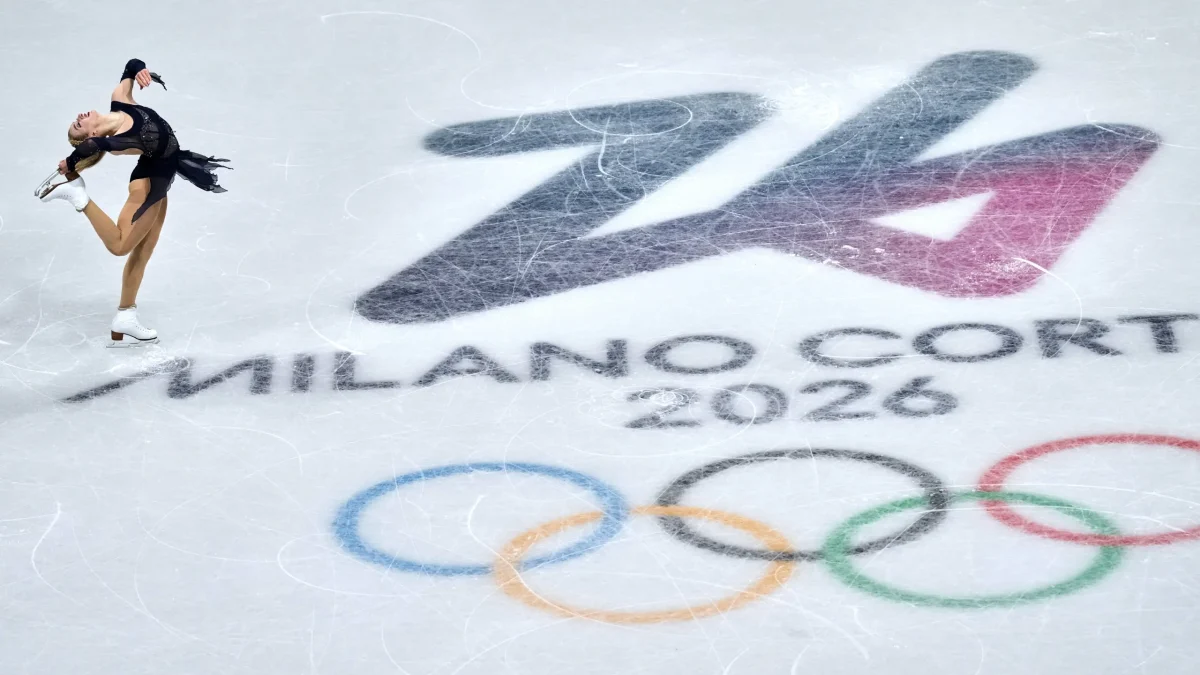
This New Year’s, the tick of the clock from 11:59 pm to midnight didn’t just mark the beginning of 2026 for figure skaters (including myself) around the world; it marked the year of the long-anticipated thrill of the Winter Olympics, which only hit our screens once every 1,460 days.
Though the Olympics itself occurs every four years, the history that took shape in the figure skating realm over those seventeen days this Olympic season is something you may only see once in your lifetime.
Many skaters landed in Milan as figures only known within the skating community, and took off two weeks later as global superstars. Take Alysa Liu, whose Free Skate program earned her a score of 150.20 after landing seven triple jumps within four minutes, easily placing her first overall, and making her the first American woman to take home a gold medal in figure skating in twenty-four years.
Liu also made history in previous years as the youngest ever U.S. national champion (age thirteen), as well as being the first American woman to land a quadruple Lutz in competition, first American woman to land three triple axels in one program, and the first woman ever to land both a quad and a triple axel in a single program.
In 2022, at only sixteen years old, Liu retired from competitive figure skating, stating that she no longer enjoyed the sport, and that her “happy place” began morphing into a source of stress. She recalled times when she would sob incessantly for hours during practice sessions, becoming severely depressed and struggling with the unrealistic physical expectations and eating disorder culture that is prevalent within the figure skating community. Instead, she spent her time pursuing her education before announcing her return to the sport in 2024, currently a college student at UCLA.
After a two-year hiatus, Liu has changed her approach in competition, her comeback being one of the most successful in history. To avoid the stress she experienced as a younger skater, Liu decided to say goodbye to her claim to fame, leaving the quads and triple axels in 2019. Instead, she stuck to slightly more basic double and triple jumps, focusing less on the shock factor of record-breaking stunts, and more on emotion, fluidity, technique, and dynamics in her performance.
Evidently, this decision paid off, earning her two gold medals for her Individual Long Program and Team Short Program. Though her Individual Short Program was her lowest scoring routine, she still delivered an astonishing performance, landing her signature triple Lutz-triple loop combination in the second half of her program that–despite being deemed as underrotated–earned her a 10% bonus with 11.71 additional points for that element alone.
Among the general public, Liu is known for her alternative style; her piercings, tattoo, and blond-black striped hair deviate from the traditional figure-skater aesthetic. Liu says she prefers self-expression over conformity, and feels her unique look better represents herself as an artist and as an individual. Liu is also very vocal about her political beliefs; she comes from a politically active family of Chinese immigrants and publicly identifies as a leftist, advocating for racial equity and LGBTQ+ rights while condemning the U.S. Immigration and Customs Enforcement (ICE) agenda.
Liu isn’t the only skater who prides herself in her individualism; the entire 2026 U.S. Olympic Women’s Figure Skating Team, also known as “The Blade Angels” is known for their unconventionality. The group consists of Liu, an alternative-presenting, first-generation immigrant; Amber Glenn, the first openly queer woman to represent America in Olympic figure skating; and Isabeau Levito, also a first-generation immigrant as well as a teenage rookie and underdog in the community. Together, these three young women formed a dream-team that made a global impact not only through their competitive performances, but also through their advocacy and authenticity.
Of course, we can’t talk Olympic figure skating without mentioning America’s Ilia Malinin, also known by his nickname, “Quad God”, coined in 2022 when he became the first and only figure skater to land a quadruple axel in competition, thus making him the only person to this day that can execute all six types of quadruple jumps. Malinin–generally considered one of the greatest figure skaters of all time at only twenty-one years old–made his Olympic debut this year after winning twelve consecutive international events. As expected, Malinin demolished competition in the Team Free Skate event, landing five quadruple jumps and as well as an iconic one-legged back-flip in his Short Program. Though skater Surya Bonaly landed the move during the 1998 Nagano Olympics, Malinin was the first to do so legally since the fourty-seven-year-long ban on the jump was lifted.
Despite his extremely promising track record and one-of-a-kind technical abilities, Malinin surprisingly did not place on the Individual Men’s podium after a generally poor performance in his Long Program. Malinin fell twice during the routine, one of the jumps he popped notably being his quadruple axel, which he expressed that he had been excited to incorporate into his program and “make Olympic history”.
It was clear from the moment Malinin stepped on the ice for his Long Program that something was weighing him down; the skater appeared visibly tense and overwhelmed.
After the program, Malinin left the rink suppressing tears, clearly extremely frustrated and upset with his performance. Despite falling short in his Long Program and not reaching the podium in the Men’s Individual ranking, Malinin made an overall impressive Olympic debut, and we can likely expect to see him again in 2030.
The U.S. wasn’t the only country that left its mark in Olympic figure skating this year; Kazakh skater Mikhail Shaidorov won gold in the Men’s Individual event, becoming his country’s first ever Olympic medalist. Shaidorov climbed from fifth place after the Short Program, landing five quadruple jumps during Free Skate, which carried him to first.
France’s Laurence Fournier Beaudry and Guillaume Cizeron shocked viewers by outpacing iconic American duo Madison Chock and Evan Bates in Ice Dancing, taking the gold after an astoundingly precise and passionate performance.
Anastasiia Metelkina and Luka Berulav of Georgia brought home their country’s first ever medal in Olympic Figure Skating, placing second in Pair Skating, just behind Riku Miura and Ryuichi Kihara of Japan–who made their own national history as Japan’s first gold medalists in Pair Skating.
Of course, we can’t cover any figure skating event without mentioning the main attraction: the triple axel (3A), which was formerly deemed the most difficult skill in figure skating considering it requires 4.5 rotations (a single axel rotates 1.5 times), making it even more challenging than any quadruple jump. Even though there is now one individual capable of landing a quad axel, the triple variation of the jump remains one of the most difficult figure skating elements and one of the most popular measures of aptitude within the sport.
This jump has had the public hooked since its first successful execution by Canada’s Vern Taylor in 1978. When it comes to figure skating, everyone seems to be obsessed with the triple axel, the question constantly being: Who can do it and who can’t?
This Olympic season, there were only four clean landings of the 3A, though it was planned by seven skaters–four women: Japan’s Ami Nakai, America’s Amber Glenn, South Korea’s Lee Hae-in, and Adeliia Petrosia (an Independent Neutral Athlete, the title Russian athletes have been competing under since the country’s Olympic ban following its conflict in Ukraine), as well as three men: America’s Ilia Malinin, South Korea’s Cha Jun-hwan, and Japan’s Yuma Kagiyama. All but Petrosian and Lee went through with actually attempting the 3A in their program. Of those who tried, all five technically did land the jump. However, Cha’s axel was deemed as underrotated and therefore was not qualified as a clean landing, while Glenn managed to land three clean executions, making history as the first American Woman to land three triple axels at a single Olympic Games.
Now, it’s not a mystery who the figure skating superstars of this Olympic season are; if you’ve opened social media at all in the last few weeks, you’ve likely come across the same two names time and time again: Alysa Liu and Ilia Malinin. To close off our recap, I’d like to discuss my favorite underrated skater from the Milano Cortina 2026 Winter Olympics.
First, a few honorable mentions:
Ami Nakai of Japan, who, at just seventeen years old, became only the sixth woman to cleanly land a triple axel at the Winter Olympics, earning a personal-best score of 78.71 in her Short Program and placing third overall.
Mikhail Shaidorov of Kazakhstan, who placed first in Men’s Singles, was one of the most shocking wins in the history of the sport. The three superpowers of figure skating–and many Olympic sports–are the United States, Russia, and Japan. To have a winner from outside of these nations is staggering enough in and of itself, but to have one from a country that many cannot even locate on a map and has never once won any Olympic medals is a monumental accomplishment for Shaidorov and Kazakh people everywhere.
However, my overall favorite underrated skater from the 2026 Winter Olympics is the third member of the Blade Angels: 19-year-old Isabeau “Ice Princess” Levito (18 at the time of competition), who made her Olympic debut this year after continuously demolishing competition at just about every major event for the past few years.
Her most notable titles include: World Championship silver medalist (2024), Grand Prix Final silver medalist (2022-2023), Grand Prix de France gold medalist (2023), six-time International Skating Union (ISU) Grand Prix medalist, five-time ISU Challenger Series medalist (three-time champion, one-time first runner-up, one-time second runner-up), and four-time U.S. national medalist (one-time champion, three-time second runner-up).
Unfortunately, Levito, being an Olympic rookie, was largely overshadowed in media coverage by her teammates, Alysa Liu and Amber Glenn. Levito had a promising start, beginning just behind Nakai on her Short Program, executing both a clean double axel and triple-flip-triple-toe combination. However, after falling on her opening jump (a triple flip) in her Free Skate program, causing her to then abandon her planned triple-triple combination, it was clear that Levito would not reach the Individual podium this year.
Despite ultimately placing 12th in Singles, she still delivered multiple incredible performances and left her mark with her impactful Olympic debut.
What stands out to me the most about Levito is her gracefulness, which sets her apart from her teammates. While all three girls are poised on the ice, they each have their own distinct focuses when competing: Glenn focuses on skill and difficulty, evident in her clean 3A execution in her Long Program; Liu focuses on expression and dynamics, especially noticeable in her bright and passionate Olympic Gala performance; Levito focuses on elegance and precision, demonstrated in her scrupulous Short Program.
Judges consider her to be the “prima ballerina” of the group; every movement radiates grace and careful intention. Not even a hair is out of place when Levito performs. Even after taking a rough fall at the beginning of her Free Skate program, Levito continued with poise, maintaining her composure and signature delicacy through the rest of her layout–a double axel, triple loop, triple-Lutz-double-toe, triple Salchow, triple-flip-double-toe-double-loop, and double-axel-sequence respectively.
Hopefully, Levito will get the opportunity to hit the Olympic rink again in 2030 and finally get the recognition she deserves.
Overall, the 2026 Milano Cortina Winter Olympics was a monumental year for figure skating. This season delivered a memorable blend of historic achievements, artistic performances, and emerging international talent. Champions such as Alysa Liu in women’s singles and Mikhail Shaidorov in men’s singles highlighted a changing competitive landscape, while standout performances in pairs, ice dance, and the team event demonstrated the depth and global reach of the sport. With the Milano Ice Skating Arena serving as the stage for dramatic moments and breakthrough victories, the competition not only celebrated the technical and artistic evolution of figure skating but also set the tone for the next Olympic cycle. As athletes and fans look ahead to the 2030 Winter Olympics, the legacy of Milano Cortina 2026 will be remembered for its new champions, historic milestones, and the continued growth of the sport on the world stage.