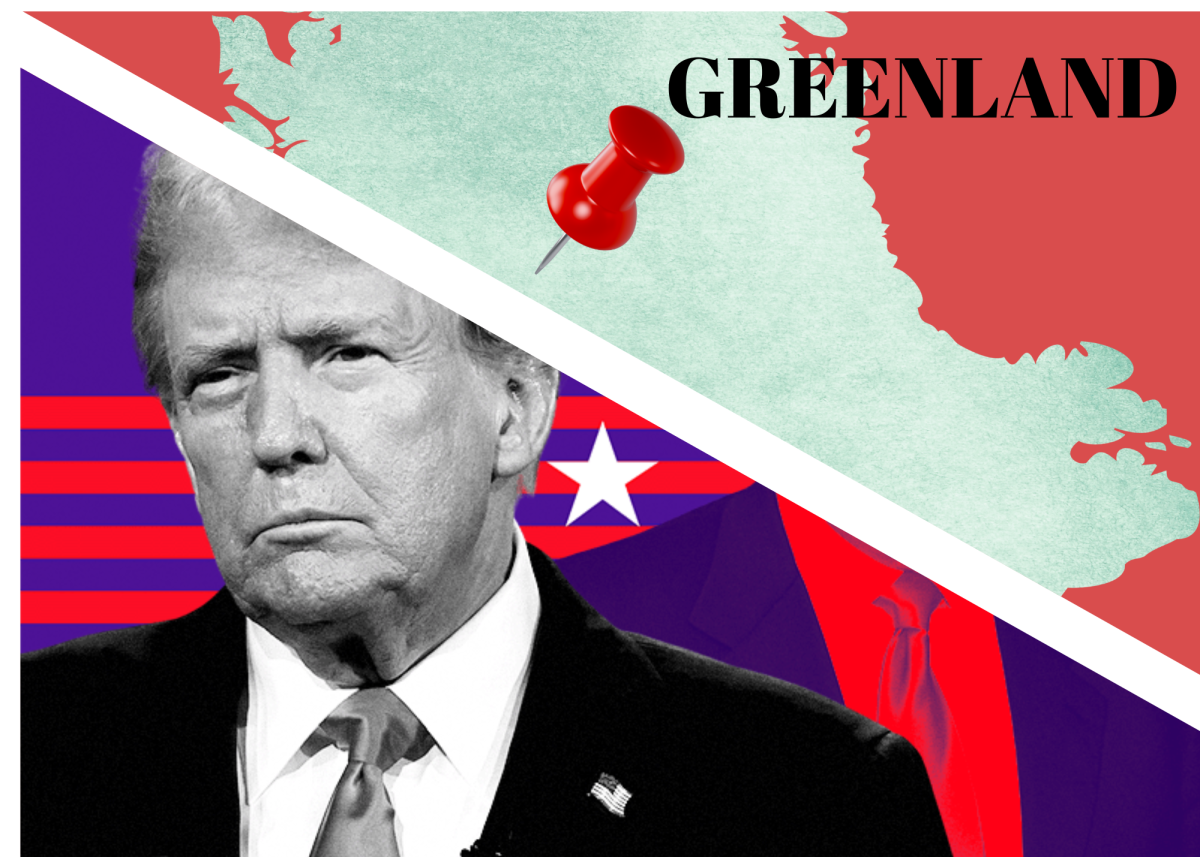
President Donald Trump’s latest push to gain control of Greenland has turned into a major disagreement between the United States and Europe. Trump argues that Greenland is crucial for American security and wants the U.S. to take ownership, but Denmark and other European nations are refusing to give in.
Greenland is part of the Kingdom of Denmark and has its own government, but it is still officially tied to Denmark. Trump has claimed that the United States needs Greenland to protect itself from threats in the Arctic and to prevent Russia or China from gaining influence there. He has also warned that if Denmark and its allies do not cooperate, the U.S. could impose new tariffs on European goods.
At the World Economic Forum in Davos, Trump said he would not use military force to take Greenland. However, he still pushed for immediate talks and warned allies that the U.S. would remember those who refused to support his plan.
Kristin Pommerenke-Schneider, social studies teacher, said she believes Trump’s focus on Greenland may not match the priorities of his voters.
“I’m sure Trump voters didn’t even know about his intentions toward Greenland,” Pommerenke-Schneider said. “So why did he have his eyes on Greenland?”
Her question highlights how unusual the issue is for both voters and global leaders.
European leaders responded strongly. Germany’s finance minister called the tariff threats unacceptable and said Europe would not be intimidated. French officials also criticized the idea of using trade as a political weapon against allies. Also, European Union (EU) diplomats are reportedly discussing possible countermeasures, including large tariffs on American products or limiting U.S. access to the European market.
This situation marks a change in Europe’s strategy toward Trump. In the past, many European leaders tried to handle him with caution, hoping to avoid open conflict. But now they are taking a firmer position because Trump is threatening the sovereignty of a North Atlantic Treaty Organization (NATO) ally and linking economic pressure to security cooperation.
Europe is still trying to keep the relationship from collapsing. EU officials have said they support stronger Arctic defense efforts and believe NATO can address security concerns without handing over Greenland. But the episode has raised questions about how much European nations can trust the United States under Trump’s leadership.
Denmark and Greenland have made it clear they do not want to sell the island. Greenland’s prime minister has stated that giving up sovereignty is not an option, and Denmark has insisted that any decisions about Greenland must be made by Denmark and Greenland together.
Pommerenke-Schneider added that Trump’s focus on Greenland may be more about attention than policy.
“Trump likes the attention,” Pommerenke-Schneider said. “Greenland might have just been a distraction.”
Her comment suggests the Greenland debate may be more about media coverage than serious strategy.
The conflict also has global consequences. Russia and China are watching closely, and some analysts believe the dispute could weaken the U.S.-European alliance and shift influence toward other world powers. For now, the debate continues, and Europe is trying to balance standing up to Trump with maintaining a working relationship with the United States.