
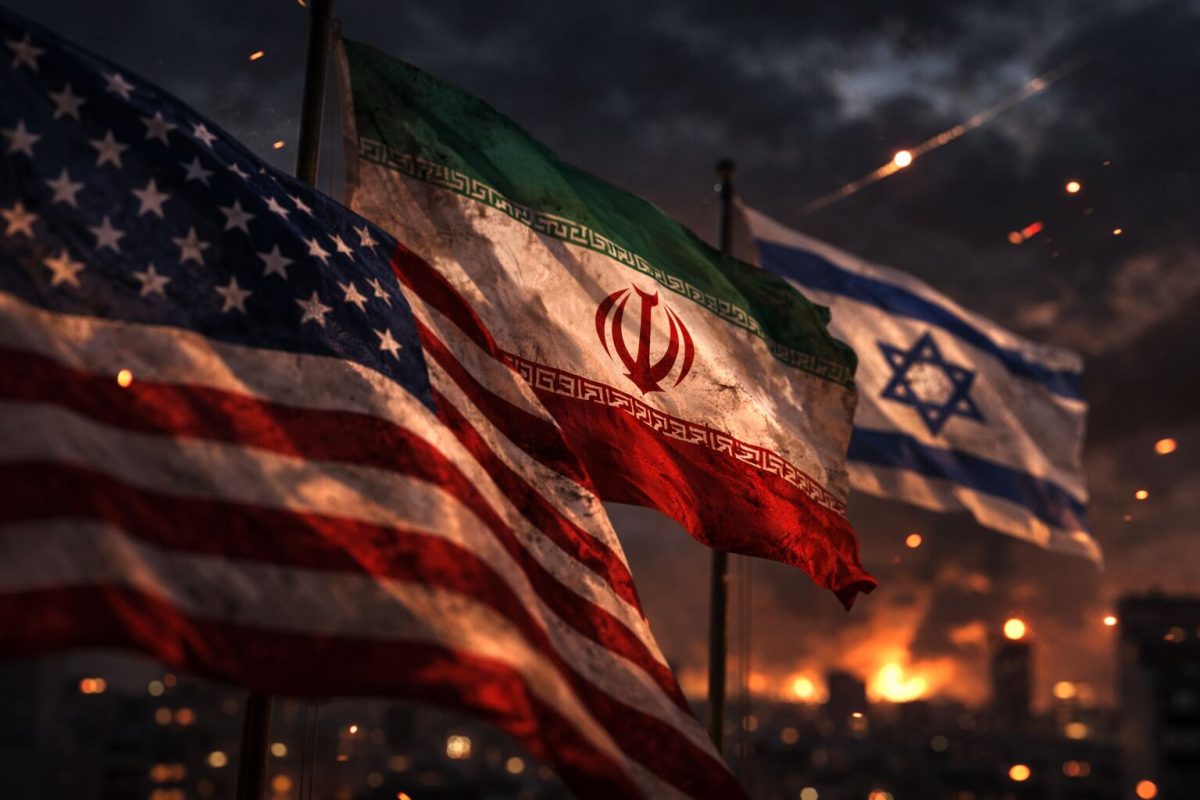
Recently, tensions in the Middle East have sharply increased following a series of military strikes involving the United States, Israel, and Iran. The conflict escalated after U.S. and Israeli forces launched coordinated airstrikes against targets inside Iran. The Trump administration refers to the strikes as operation “Epic Fury,” a vital procedure that was aimed at military facilities, missile storage sites, and locations believed to be connected to armed groups supported by Iran.
The attack targeted many cities in Iran, including Tehran, Karaj, and Qom. As of March 5, around 1,190 civilians were reported dead, including around 175 dead from a strike attack at a girls’ school in Minab, and over 100 deaths in Lebanon.
The first of the many airstrikes took place on February 28, assassinating Ayatollah Ali Khamenei, Supreme Leader of Iran. Khamenei was in power for approximately 36 years. Khamenei held authority over military and political affairs. Iran’s top clerics are still in the works to choose a successor to Khamenei.
President Donald Trump claims that the attacks were meant to stop Iran from becoming a nuclear threat to protect the United States and its allies. In a video announcement, he warned the Iranian military forces to “lay down your weapons,” claiming that the bombing will go on as long as necessary. Similarly, Prime Minister of Israel, Benjamin Netanyahu, stated the strikes against Iran were necessary due to Iran’s regime and attempts to rebuild nuclear weaponry.
After the attacks, Iran responded by launching missiles and drones at military targets connected to the U.S. and its allies in the Middle East. Some of the attacks were aimed at areas where U.S. troops are stationed and the U.S. ally Israel. Iranian leaders also warned that they would continue to retaliate if the U.S. kept attacking.
On March 5, Iran had launched a “hybrid attack” against Israel. The Israeli military issued an urgent evacuation warning for neighborhoods in Beirut’s southern suburbs. With that said, Iran has been waiting for the U.S. to strike again and is prepared to encourage any invasion, Foreign Minister Abbas Araghchi said. He told NBC News, “We are confident that we can confront them, and that would be a big disaster for them.”
President Trump told Time on a phone call that he has no set time limit on the war, with expectations of death in the war. For now, many countries are watching closely to see whether the conflict will grow or if leaders will try to reduce tensions through diplomacy.