Disclaimer: This review contains spoilers.
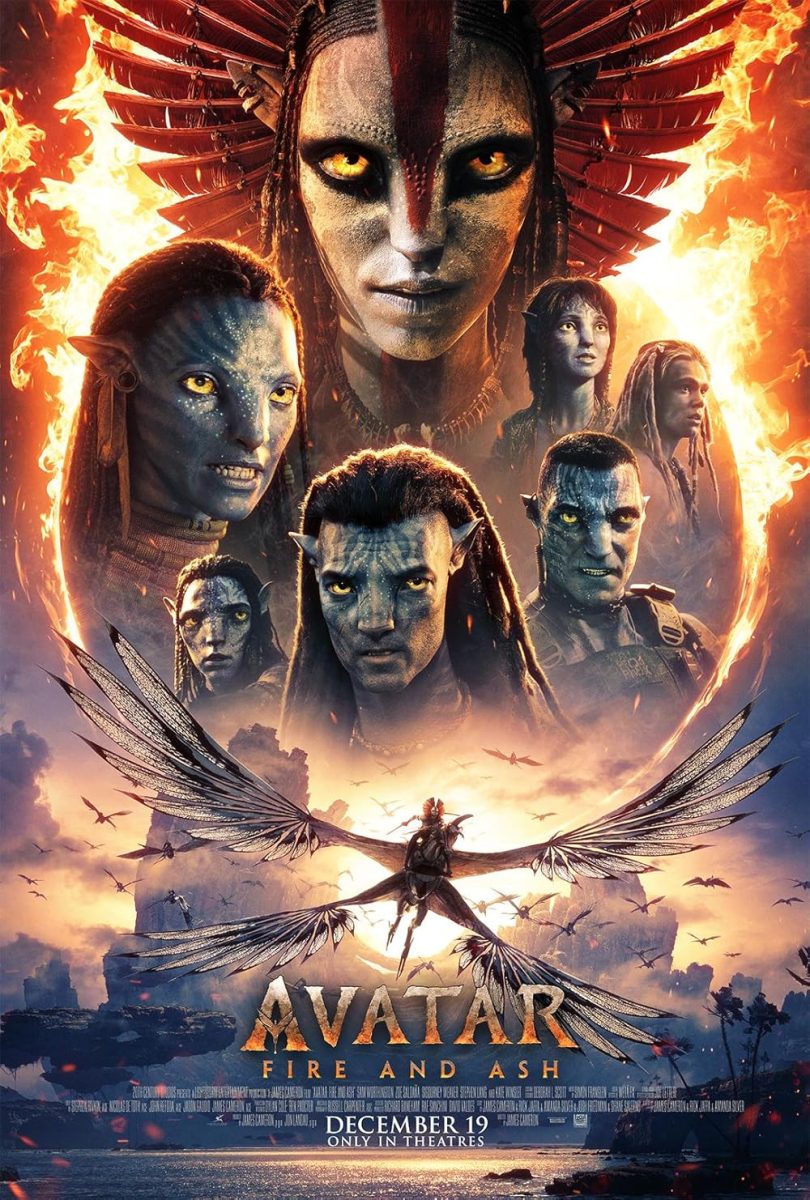
Avatar: Fire and Ash, the third installment in James Cameron’s Avatar series, was released on December 19, 2025, and has already earned over $1 billion globally. Still, while its box office success is obvious, the film has been surprisingly controversial among longtime fans. As senior Layla Shannon put it, “I thought that the movie as a whole was good, but the story line kind of fell off; there wasn’t much driving the plot.” Personally, I thought Fire and Ash stayed consistent with the emotional and narrative foundation of the previous movies. It was intense, visually stunning, and moving, even if the story didn’t always go in the direction I hoped, based on my attachment to certain characters and relationships.
One of the most impactful choices the film makes is how it opens with Lo’ak’s voice as he connects to the spirit tree, speaking to his brother Neteyam, who died in the previous movie. The two are shown flying together on their ikran, something they loved to do, which makes the scene feel peaceful and deeply personal. Just before the film cuts back to reality, Neteyam asks Lo’ak how he died, immediately grounding the story in grief and unfinished loss.
That grief is most clearly seen through Neytiri. Her mourning is raw and angry, and while it’s heartbreaking to watch, it feels real. Rather than softening her pain, the film allows it to exist fully, shaping both her character and the choices she makes moving forward.
Lo’ak continues to be one of the most compelling characters in the franchise. He typically pushes the plot forward through impulsive, teenage mistakes, but Fire and Ash gives him more emotional depth. He carries guilt over Neteyam’s death, something both he and Jake sometimes believe was his fault. The film doesn’t shy away from highlighting how deeply this affects him, showing how his guilt pushes him to a breaking point. Still, his growth is clear. Lo’ak begins to step into his own identity, moving away from simply trying to prove himself and toward understanding who he actually is.
Jake Sully, however, feels less predictable. As a father, he pivots between harshness and tenderness, especially toward Lo’ak, in his case tending to be harsh—at times, it almost feels like resentment. Yet, with Neytiri, he is patient and grounding, helping her channel her grief into survival and battle. This contrast makes Jake complicated, but not always easy to sympathize with.
The introduction of Varang, Olo’eykte (clan leader), and Tsahìk (spiritual leader) of the Mangkwan tribe is one of the film’s strongest elements at first. Her rage is rooted in loss, and particularly the destruction of her sacred tree, which severed her people’s connection to Eywa. This backstory adds nuance to the Mangkwan’s violence and use of fire. Even though she was introduced as a character that would play a large role and be the main antagonist, unfortunately, as the movie went on, Varang’s role becomes too closely tied to Quaritch, which limited her potential. I would have liked to see her journey explored more independently, possibly even turning against him.
Quaritch himself feels like the weakest part of the story. His obsessive hatred of Jake no longer makes much sense, especially considering he has become exactly what he once despised by fully integrating into Na’vi life. His continued vendetta feels repetitive, and the movie could have benefited from giving him a stronger, more interesting motivation.
Another storyline that didn’t work for me was the romance between Spider and Kiri. Given that they were raised like siblings and share the same parental figures, the relationship felt uncomfortable and unnecessary. If a romance needed to be developed, Lo’ak and Tsireya would have made far more sense.
As always, the film’s visuals are stunning, and beneath the action, Fire and Ash continues Avatar’s commentary on colonization, showing the Sky People building over the land, displacing the Na’vi, and treating them like “savages,” which draws clear parallels to the history of Indigenous peoples in the United States.
Overall, Avatar: Fire and Ash is not perfect, but it is emotionally rich, visually beautiful, and ambitious. Despite taking place in a completely different world with people who look nothing like us, the characters feel real and familiar in the way they love, grieve, and make mistakes. Because of that, the film left me invested and very excited for what comes next in the series.