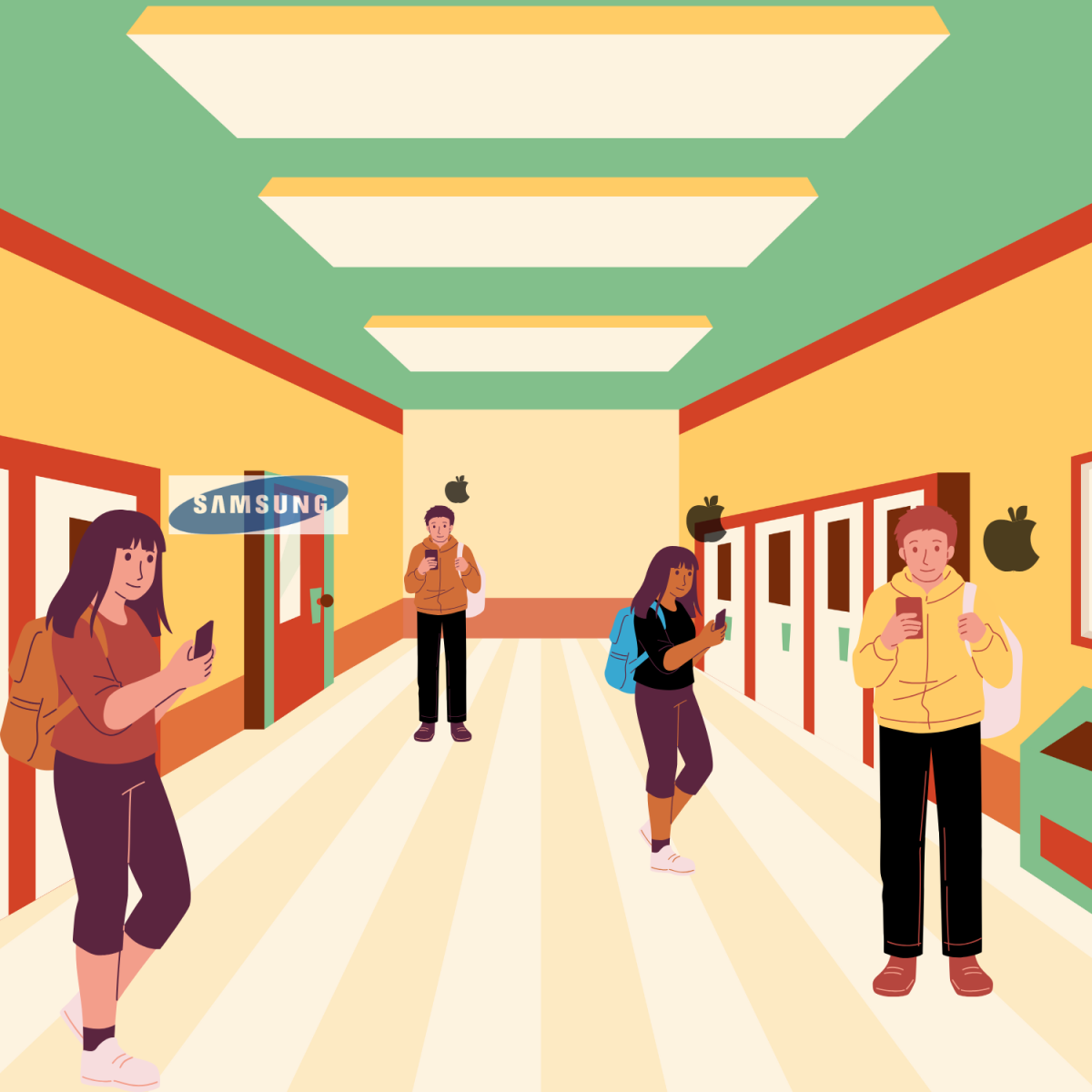
Walking down the hallway between fourth and fifth period, I can’t help noticing how every hand seems to be holding a phone. Someone has theirs balanced on top of their tote bag, someone else is squeezing theirs between two textbooks, and another girl is casually FaceTiming while weaving through the hallway like it’s nothing. And almost every single one of those phones is an iPhone, which makes sense considering around 87% of teens have one.
What stands out to me isn’t the number of iPhones; it’s the quiet expectation around them. Using anything else isn’t treated as wrong, but it’s definitely seen as uncommon. When someone mentions having a Samsung or an Android, the room doesn’t go silent or anything dramatic, but there’s often a small moment of surprise, like it’s not what people anticipated. It makes me wonder why we’re all so committed to choosing the exact same thing.
It’s not as if iPhones are perfect; plenty of them have cracked screens or batteries that barely last the school day. Still, they’ve become the “default” choice, the one people assume you have without even thinking. Other phones aren’t mocked, but they tend to be viewed as out of the ordinary. That made me start questioning whether iPhones are truly better or if we’ve just gotten used to following whatever everyone else already uses.
The more I researched and thought about it, the more I realized that most people don’t choose iPhones because they’re the best. They choose them because they’re familiar, popular, and predictable. Not only that, but a lot of teens don’t even choose their own phone; their parents do, and parents often follow the same trends. “I got an iPhone from my parents years ago, and I never really questioned it,” senior Elyan Jamal said. “I did not think of it as following a trend. I was just excited to have a phone.”
It’s a cycle that keeps going, even if no one pays attention to it. When you actually compare them, Samsung has plenty of real advantages, details most people never think about.
Firstly, their screens are brighter, smoother, and more colorful, which makes TikTok, Netflix, or whatever else you’re watching look noticeably better. Also, their cameras can reach high megapixel counts, maximizing the zoom feature. They charge faster too, with 45W charging compared to Apple’s 20-30W. And the reverse wireless charging is another perk, as it allows you to use your phone to charge your other devices.
“I have an iPhone right now, but if I had the money, I would probably switch to a Samsung because I am really into cameras, and theirs are great,” Senior Diego Juarez-Prado said. “I think people choose their phones based on what they want out of them. I do not have anything against Samsung.”
Samsung also gives users more freedom. While Apple sticks to a “you get what you get” vibe, Samsung lets you customize almost everything, from icons to whole themes. Features like split-screen multitasking and Samsung DeX, which turns your phone into a computer, make the device feel like something you can actually make your own.
Then there’s the price. Samsung offers a range, from budget to mid-tier to high-end, while Apple’s lineup seems to start at an expensive price and climb from there. Samsung phones often include chargers, more storage, and sometimes even microSD slots, while Apple charges more for the basics. It starts feeling less like a thoughtful purchase and more like a status symbol, something you buy because it “fits in.”
And here’s the part I can’t ignore: I own an iPhone too. I’m not above any of this. I didn’t spend hours comparing features or deciding what worked best for me. I got the phone my parents bought for me and have been grateful since. I’m part of the trend, even while recognizing how strong the trend is.
Thinking about all this made me see how many “choices” teens make without really choosing. Phones are just the easiest example. The same thing happens with what we wear, what bags we carry, and even what kind of water bottle everyone suddenly needs. Trends turn into expectations so quickly that we forget there were any alternatives to begin with.
A few days later, I walked down that same hallway again, passing the same faces and the same clusters of conversation. The same iPhones glowed in nearly every hand, just like before. But something felt different to me. I wasn’t just seeing phones; I was seeing habits. Patterns we follow without thinking. Little decisions that say more about fitting in than about what we actually like. I now understand that the brand on a phone doesn’t matter as much as the reason we reach for it without asking why.