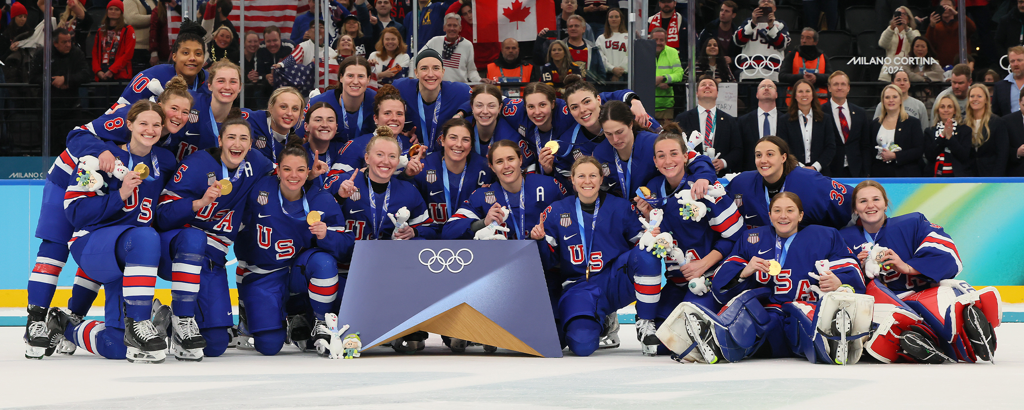
On February 19th, 2026, at the 2026 Winter Olympics, the United States Women’s Ice Hockey Team completed the tournament with a perfect 7-0 record, scoring 33 goals and allowing only two. In the final game, they brought home the gold after beating Canada 2-1 in overtime, when defender Megan Keller scored the final goal about four minutes into the extra period, slipping a shot through the goaltender’s legs.
The championship game was one out of the history books, featuring numerous smart, calculated plays, impressive athleticism, and raw talent. It was a powerful reflection of the dedication, skill, and hard work the team had built over years of preparation.
Unfortunately, the team only had a few hours to bask in the warm glow of winning a gold medal before President Donald Trump overshadowed it. During a post-game call with the U.S. men’s team, he said, “And we have to, I must tell you, we’re going to have to bring the women’s team… you do know that,” referring to the State of the Union event, prompting the room to erupt in laughter.
The phrasing itself—“we have to,” as if inviting the women’s team weren’t a given—is absurd. Acting as though it’s a burden to recognize the women, who had just won the same gold medal as the men, is blatantly sexist. On top of that, making the entire statement a joke at their expense, attempting to embarrass them, was completely inappropriate, and the men’s team laughing only made it worse, reflecting poorly on their character as individuals and as a team.
This situation is just another example of Trump’s constant pattern of offensive, inappropriate, and disrespectful comments, exacerbated by the team’s reaction. Worse than that, it reflects a broader pattern of dismissive, belittling, and undervalued treatment of women’s sports.
In this situation, the team’s achievement has been overlooked because of the president’s comments and the men’s team’s reaction. Now, whenever you search for the women’s team, the first thing that appears is coverage of the president’s remarks and the men’s team “being under fire” for their response. For many, the team risks being remembered not for their gold-medal victory, but for a comment made about them and their decision to decline the State of the Union invitation.
USA Hockey explained that the athletes were unable to attend due to timing and previously scheduled academic and professional commitments, but it’s reasonable to think that the president’s rude remarks also influenced their choice.
Senior Ava Reotutar, a female athlete herself, said, “It was completely valid for them to decline the State of the Union invitation, and that decision deserves some respect. Choosing not to attend helps challenge the ¨boys will be boys¨ mindset and sends a message that rude, dismissive behavior should not be accepted or ignored. Comments like these contribute to the wide gender gap in sports by making women seem less valued and less capable.”
This situation is unfortunately typical for women’s sports, where achievements are often overlooked or undervalued compared to men’s. As a female athlete myself, I find it deeply disappointing. It reminds me of attending a women’s basketball game at my school, often scheduled at times when few can come, and seeing nearly empty bleachers. Then, at the men’s game, the stands are packed. This is not because the men’s team is inherently better, but because that is treated as the norm.
Women’s sports often receive less recognition simply because they are women. In addition, many female athletes are paid less, receive less funding, and face persistent sexist ideas about what sports are “appropriate” for girls.
This environment makes it harder for young girls to stick with sports. Some are discouraged because athleticism is sometimes labeled “unladylike” or because society undervalues their strength and skill. Participation often drops as girls reach high school, and many never see the value in their own athletic abilities.
These barriers make the achievements of the U.S. Women’s Hockey Team even more remarkable. Despite a system that often undervalues women’s sports and the comments they faced, they persevered and earned gold.
Ultimately, while it is important to acknowledge the disappointing and inappropriate comments made by the president and the reactions of the men’s team, it is equally necessary to celebrate the women’s team and recognize their accomplishments.
They deserve to be remembered and admired for their skill, dedication, and historic achievement. Highlighting their success not only ensures their legacy is positive and lasting, but it also has the power to inspire the young girls watching. They can see that, despite obstacles, they too can be strong, resilient, and capable of achieving greatness, just like the 2026 U.S. Women’s Ice Hockey Team.